How to Play Blackjack in New Zealand
 Available in US
Blackjack is won by finishing closer to 21 than the dealer without exceeding the limit, with choices along the way shaping each hand.
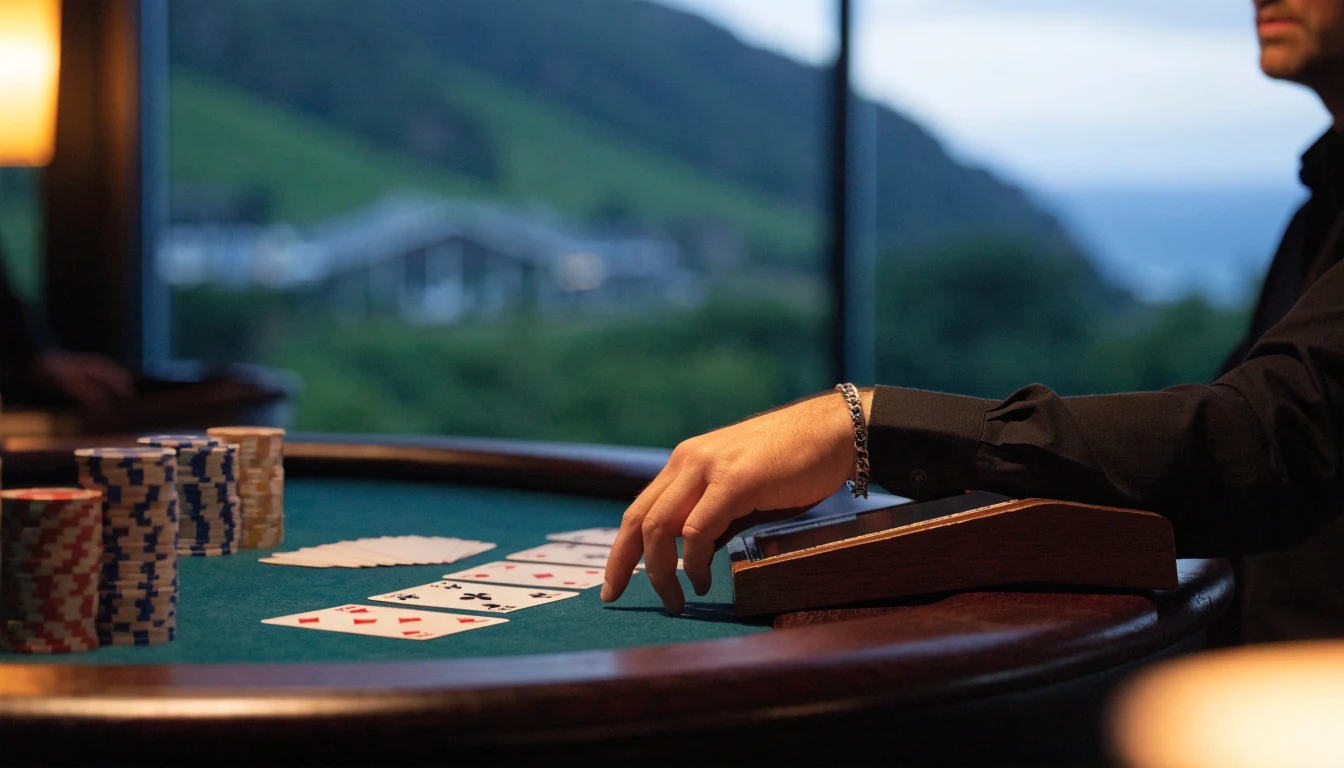
Table of Contents
- The Aim of a Blackjack Hand
- Playing Blackjack Online for Free
- Free Play for Practice, Not Promises
- Online Blackjack and New Zealand’s Licensing Framework
- How Table Rules Shape Blackjack Strategy
- Playing With Others and the Limits of Card Counting
- What the Blackjack Game Involves
- The Decisions You Can Make During a Hand
- Card Values Beginners Need to Know
- Simulators, Bets, and Playing Two Hands
The Aim of a Blackjack Hand
Blackjack is a comparison between your hand and the dealer’s. The aim is to finish closer to 21 than the dealer without going over it. You are not trying to beat the other people at the table, and you do not need to reach 21 exactly to win. What matters is how your final total compares with the dealer’s, while staying within the limit.
That distinction is easy to miss when you are new to the game. A hand can be successful without making 21: if your total is nearer to the target than the dealer’s and neither hand has gone over, you have the stronger result. A hand can also be unsuccessful even when it looks substantial, if the dealer finishes closer to 21. The number is a ceiling as well as a goal.
Going over 21 means the hand has gone bust. Once that happens, being closer to 21 than the dealer no longer helps: the hand has exceeded the limit that defines the game’s objective. This is why blackjack is not simply a race to collect as many points as possible. More is useful only while the total remains within the boundary.
Choosing where to play blackjack in New Zealand in 2026 means checking the information available about each casino before you sign up. Use these details as a starting point when deciding what to look into further.
License: Malta Gaming Authority, licence no. MGA/B2C/370/2017 Play Grand is listed with a Malta Gaming Authority licence, number MGA/B2C/370/2017. You can use that licence detail as one point of reference when assessing the casino.
Payout speed: 1-3 business days Lamabet lists a payout speed of 1–3 business days. You can consider that timeframe when reviewing its payment information.
License: Tobique Gaming Commission, licence no. 0000064 Neospin is listed with a Tobique Gaming Commission licence, number 0000064. You can take this licensing detail into account when assessing the casino.
License: Tobique Gaming Commission, licence no. 0000002 Ricky Casino is listed with a Tobique Gaming Commission licence, number 0000002. You can use this information as part of your review.
License: 07017519840 · Payout speed: 1-3 business days Zotabet has the licence reference 07017519840 and lists a payout speed of 1–3 business days. You can consider both details when reviewing the casino and its payments.
Payout speed: 1-3 business days Wintino lists a payout speed of 1–3 business days. You can check this against your expectations when reviewing its payment terms.
License: Curaçao Gaming Authority, licence no. OGL/2024/165/0185 BitStarz is listed with a Curaçao Gaming Authority licence, number OGL/2024/165/0185. You can use this licence information as one point of reference.
License: Tobique Gaming Commission, licence no. 0000091 7Bit Casino is listed with a Tobique Gaming Commission licence, number 0000091. You can take this detail into account as you assess the casino.
License: Malta Gaming Authority, licence no. MGA/B2C/394/2017 N1 Casino is listed with a Malta Gaming Authority licence, number MGA/B2C/394/2017. You can use the stated licence information as part of your review.
It helps to think about the aim in two parts. First, your hand must stay at or below 21. Then it is compared with the dealer’s hand. Both parts matter. A total close to 21 may seem strong, but the comparison is not decided until the dealer’s result is known. Conversely, a modest total is not automatically a loss; its meaning depends on what the dealer finishes with.
The dealer is your opponent in the hand, even when other players are seated beside you. Their results do not decide whether your hand is closer to 21 than the dealer’s. Each player is judged against that same dealer hand. This keeps the central question simple: did your hand stay within the limit, and did it finish nearer to 21 than the dealer’s?
There are several possible broad outcomes. Your hand may finish closer to 21, the dealer’s may finish closer, or the comparison may be even. The exact treatment of an even result can depend on the game’s rules, so it is worth understanding that before you play. But the basic objective remains the same: compare the two hands, with 21 as the upper boundary.
A common beginner’s mistake is to treat reaching 21 as the only way to succeed. It is not. If you focus only on making that exact total, you may overlook the real contest: finishing nearer to 21 than the dealer without exceeding it. The target gives you a reference point, not a requirement that every hand must meet. A lower total can still be enough; a higher one can fail if it crosses the limit.
The opposite misunderstanding is to assume that any total under 21 is safe. It is only eligible for comparison. The dealer may still finish closer to the target, so staying under the limit does not by itself settle the result. In other words, avoiding a bust is necessary for a hand to remain in contention, but the dealer’s final position matters too.
If you are learning how to play blackjack at a casino, keep this objective in view before worrying about what to do in a particular situation. The game is not about making the largest possible total or copying the choices of someone nearby. It is about managing a hand in relation to a fixed limit and an opposing dealer hand. The details of how a hand changes belong to the rules and decisions that follow, but the purpose does not change: get closer to 21 than the dealer while remaining at or below it.
This also explains why the name “blackjack” should not lead you to expect that every win requires a special hand or an exact total. The central contest is broader than that. Each hand is assessed by its final position relative to 21 and the dealer’s result. Once you understand that, the game’s aim is clear, even before you learn the values assigned to individual cards or the choices available during play.

For a first visit to a blackjack table, that is enough to orient you: the dealer is the person you are playing against, 21 is the limit, and closeness matters only when you have not gone over. Keep those points together rather than treating them as separate rules. They describe the basic test every hand faces, whether you are learning the game or returning to it after a long break.
Playing Blackjack Online for Free
Free online blackjack gives you a way to open a game and take part without wagering real money, when a free-play mode is available. The experience depends on the format behind the screen. Some games use software to deal and shuffle cards; others show a live dealer handling actual cards. Knowing which you have opened helps you understand the pace and what the game is simulating.
A free mode is not necessarily a separate game. It may be a practice setting within a blackjack title, with virtual credits replacing cash wagers. Those credits are for playing in that setting; they are not a balance you can withdraw. Availability and presentation vary, so look for clear wording such as “demo” or “free play” before you start. If the game instead asks you to make a real-money deposit or place a cash wager, you are not in a free session.
Software-based blackjack
Online blackjack using a random number generator, or RNG, relies on software to determine the cards. The game shuffles through software rather than showing a dealer physically mixing a deck. As a result, hands can move quickly: there is no need to wait for a live dealer to deal, respond to players or prepare the next round.
This format suits a short session or a quick look at how a digital table is presented. The screen typically shows the cards, the dealer’s hand and controls for interacting with the game. The exact layout and controls depend on the title. Some games may include audio or animations, while others keep the presentation simple. These features change the feel of the session, not the fact that the cards are generated by software.
A free version of an RNG game can look similar to its cash-play counterpart, but that does not mean every setting or feature will match. Treat the free mode as its own session and check what the screen says about the game you have opened. If the interface is unclear about whether you are playing with virtual credits or real money, pause rather than assuming.
Live-dealer blackjack
Live-dealer games use actual cards dealt by a person and shown through a video stream. The screen brings a physical table into the online experience, with the dealer and cards visible as the hand unfolds. This differs from an RNG game, where the dealing is simulated by software, even if both are presented on a screen.
Live-dealer games use a video stream to show a person dealing actual cards, whereas RNG games rely on software to determine the outcome.
The stream affects the pace. A live game may take longer because the dealer has to deal and manage the table, and video streaming can add delay. Live-dealer games may also require higher bets than software-based games. That can make a live table unsuitable for someone simply looking for a no-cost session: check that a free-play option is genuinely available rather than assuming every live game can be tried without wagering.
The two formats are not interchangeable in how they feel. An RNG table moves at software speed and may be easier to enter and leave between hands. A live table offers a view of actual cards and a dealer, but the stream and table pace shape the experience. Neither description alone tells you whether a particular title has a free mode.
Finding a genuinely free session
When you look for free online blackjack, focus on the labels and actions on the game screen, not just a general description of the site or title. Check whether the game says demo, free play or practice, and whether it asks for a cash balance before dealing. A free session should not require you to place a real-money wager. If the distinction is uncertain, do not proceed until it is clear.
“Online” also does not necessarily mean “no download.” Some games may open in a browser, while others may be offered through an app or a platform with its own access requirements. Check how the particular game is launched before expecting to play immediately. The same applies to multiplayer features: a game may offer a shared or social setting, but that does not establish that the table is free. Confirm both the format and whether any real-money wagering is involved.

Free play is a way to use an online version without staking cash; it is not a promise that every game, including every live-dealer or multiplayer title, has a free option. Once you know whether the cards come from software or a live stream, and whether the session uses virtual credits or real money, you can choose the format that matches what you are looking for.
Free Play for Practice, Not Promises
Free play can make blackjack feel less demanding while you get used to following a hand. Without a real-money stake attached to each decision, you can take time to notice what is happening, try the available choices and enjoy the pace without treating every result as a verdict on your ability. It is a way to become more familiar with the game, not a shortcut to winning later.
You might use a free game simply for entertainment. You can also use a few hands to get comfortable with the rhythm: look at your cards, consider the situation and see how the hand develops. There is no need to turn that into a formal lesson. If you are curious about a choice, pay attention to what follows; if you would rather play casually, there is nothing wrong with that either.
- Use free play to become familiar with the game rhythm
- Notice how different choices affect the hand
- Use a low-pressure environment to learn card values
- Treat free play as a shortcut to winning later
- Use a winning streak as a forecast for real-money play
- Mistake immersive presentation for strategic insight
Make practice low-pressure
A useful practice session does not have to be long or serious. Try a few hands, pause when you feel distracted, and return another time if you still want to play. Keeping the experience easy to leave helps free play remain what it is meant to be: a low-pressure way to spend time with the game.
You can also use free play to become more comfortable with the cards. Number cards retain their face values, while a jack, queen or king counts as ten. An ace can count as either one or eleven, depending on what makes the hand total work without going over. Seeing those values play out can make the game easier to follow, especially if you are new to it.
Some people prefer sound because it makes a game feel more engaging; others would rather play quietly. If sound controls are available, choose the setting that suits you. The important point is not to mistake presentation for insight. Music, effects or a more immersive screen can make a session enjoyable, but they do not change what a hand is worth.
Free play is still a game, not a forecast
A favourable run in free play does not show that a similar run will happen when money is involved. Nor does an unlucky stretch prove that you are playing badly. Outcomes vary from hand to hand, and practice cannot promise a particular result. Its value is in helping you feel more at ease with the experience, not in predicting what will happen next.
It can help to notice what you are practising. Are you learning to read the cards without rushing? Are you getting used to the way a hand unfolds? Or are you just passing the time? Any of those can be a reasonable reason to play for fun. You do not need to turn every session into a test or keep going until you feel you have mastered something.
Free games may be offered in different ways, and access can depend on the site or device. A title described as playable without a download may run in a browser, but check what the particular game asks you to install or enable before opening it. Do not assume that every free option works the same way, or that “free” means there are no conditions attached to other features.
Most importantly, keep a clear boundary between playing for fun and deciding to wager real money. Free play does not establish that you are ready to do so, and it cannot remove the uncertainty of real-money play. If you choose to move on, set a budget beforehand and do not chase losses. Read the fine print and any bonus conditions before accepting an offer; wagering requirements and maximum-bet rules can apply, and blackjack may contribute differently from other games. You can also choose not to make that move at all.
A relaxed session is enough. Play a few hands, enjoy the game if you are enjoying it, and stop when it no longer feels worthwhile. Free play can help you become familiar with blackjack while keeping the focus on entertainment; it cannot make future results certain.
Responsible Gaming
Set a budget before wagering real money and do not chase losses.
Online Blackjack and New Zealand’s Licensing Framework
If you are deciding where to play blackjack online, the legal position in New Zealand matters as much as the game on the screen. The framework changed with the Online Casino Gambling Act 2026, which came into force on 1 May 2026. It creates the country’s first domestic licensing system for online casino gambling; it does not mean every site available to New Zealanders is already licensed under that system.
The Department of Internal Affairs is New Zealand’s primary gambling regulator and oversees the online casino licensing framework. Licensing decisions sit with a separate body: the Gambling Commission hears and determines casino licence applications, issues online casino licences and approves changes to licence conditions. In practical terms, the Department has the wider regulatory oversight role, while the Commission handles the licensing decisions specified under the framework.
The transition is deliberately limited. Online casinos that were already providing services to people in New Zealand before the Act began may continue operating until 1 December 2026, subject to the Act’s transitional provisions. That temporary permission is not the same as holding a licence under the new regime. The full licensed system is not expected to be operational until 2027, so a site’s availability during the transition should not be mistaken for confirmation that it has received a New Zealand licence.
The law also distinguishes between domestic and offshore gambling. The Gambling Act 2003 does not permit online casinos to be based in New Zealand, and domestic online casino gambling is prohibited. Before the 2026 Act, offshore online casino gambling was not licensed or supervised by a New Zealand regulator. A customer who wagered with an offshore website in that period had no domestic government recourse if a dispute arose. The new law establishes a path to local licensing, but the transition means that this change is not instantaneous.
That context is useful if you are comparing sites offering live blackjack, looking for a place to play with friends, or considering a casino bonus. A site being accessible, or displaying a foreign licence, does not by itself establish that it holds a New Zealand licence. Nor does a bonus make an operator’s regulatory status clearer. Read the terms and conditions carefully, including any wagering requirements, before accepting an offer; bonus rules can affect how blackjack play is treated.
During the transition, keep the distinction between existing operators’ temporary permission and the future licensing regime in view. The Act provides that the new system will be administered through the Department’s regulatory oversight and the Commission’s licensing decisions. The full regime is expected in 2027, rather than being fully operational at the start of the transition. If you are seeking professional blackjack advice or comparing ways to play online, those matters do not replace checking the legal status that applies at the time. The framework is changing, so avoid treating a site’s continued operation as proof of a completed licensing decision.
Legal Status
Do not assume a site is licensed in New Zealand just because it is accessible or displays a foreign licence.
How Table Rules Shape Blackjack Strategy
A sound blackjack decision is not determined by your cards alone. The rules printed for the table affect how a hand should be played, so a strategy that fits one version may not be right for another. Before you rely on a chart or make a choice, check the rules attached to that specific game.
The number of decks matters because it changes the composition of the cards that may still be dealt. Dealer rules matter too, especially whether the dealer must hit or stand on a soft 17. A soft 17 contains an ace counted as 11, so the dealer’s obligation can affect how likely the house is to improve its hand. These details can shift the best response to a player hand and can also change the house edge. Blackjack variants are not interchangeable simply because they share the same name.
Surrender is another rule to look for. Where it is offered, it lets you give up a hand in situations specified by the table rules rather than continue playing it. Its availability and conditions are not universal, so do not assume you can surrender when a difficult hand appears. Check the rules before the deal, and use strategy advice that matches the version you are actually playing.
Pay attention to how a natural blackjack is settled. A specialist review describes natural-blackjack payouts of 3:2 at some tables and 6:5 at others; treat those as reported examples, not a promise about every game. The payout affects the return when you receive a natural, so it is worth comparing the stated terms before you choose a table. Read the wording carefully: a natural blackjack is not simply any hand that reaches 21 after taking more cards.
Insurance deserves particular caution. It may be offered when the dealer’s visible card is an ace, but it is a separate wager rather than a way to protect every hand. For most players, insurance is generally not a sound bet. Avoid treating it as a routine choice or assuming that taking it improves the overall value of your play.
If you are learning a strategy, start by identifying the deck count, the dealer’s soft-17 rule, surrender availability and the natural-blackjack payout. Then make sure any guidance you use applies to those conditions. The best way to play blackjack is not a single fixed set of decisions for every table: rule differences can change which choices are sensible. A brief check of the table information can prevent you from following advice built for a different game.
Playing With Others and the Limits of Card Counting
Blackjack can be a shared activity, but playing alongside someone does not mean you are playing a single hand together. At a table, two people can take separate seats and make decisions for their own hands while facing the same dealer. You may talk through choices, but the result of your hand is still determined by your own cards and the dealer’s hand. Agreeing beforehand on how to play can help avoid confusion, especially if one person is new to the game.
While mental card counting is not illegal under New Zealand law, it is ineffective in RNG blackjack because the software shuffles cards continuously.
Online, the setup depends on the game. Some blackjack formats show other participants at a shared table, while others present the game as a more individual experience. In either case, seeing other players does not make their cards part of your hand or give you control over their choices. If you are playing with a friend, check how the table handles seats, turns and decisions before joining; the interface should make clear whether you are sharing a table or simply playing at the same time.
Card counting is different from coordinating with another player. It means keeping a mental estimate of which cards have already appeared and using that information when considering what remains. Using mental calculation alone for card counting is not illegal under New Zealand law. That legal point should not be confused with a promise that counting will improve your results, or with permission to use any tool a particular venue may prohibit.
Online RNG blackjack is a poor setting for card counting. The software shuffles the cards, so a sequence seen in one hand does not provide a dependable record of what will appear in the next. The pace can also be faster than at a live-dealer table, leaving less time to follow each deal. Card-counting software does not change the underlying shuffle or turn an RNG game into a predictable shoe.
If you play with another person, keep the arrangement simple: each player should know which hand is theirs, and neither should feel pressured to follow the other’s decisions. Treat counting as a limited mental exercise, not a system that removes uncertainty. Most importantly, set a budget before play and do not chase losses. Sharing a table can make the experience social, but it does not make the game safer or guarantee a better outcome.
What the Blackjack Game Involves
Blackjack is a card game in which you play against the dealer, rather than trying to beat the other people at the table. The central comparison is between your hand and the dealer’s: you want your total to finish closer to 21, but going above 21 means you have exceeded the target.
That simple aim gives the game its tension. A hand that is close to 21 can still be vulnerable if the dealer finishes nearer, while trying to improve a hand carries the risk of going over. Reaching 21 is not the only way to do well; the outcome depends on how your final total compares with the dealer’s.
If you are looking to play a blackjack game, it helps to think of each hand as a contest with two possible concerns: the distance from 21 and the distance between your total and the dealer’s. The target matters, but so does the other hand. A total below 21 is not automatically a win, and a total that is not exactly 21 can still be enough if it finishes closer than the dealer.

This is the broad structure shared by blackjack games, even though individual versions can differ in their rules. You do not need to treat the game as a race to reach 21 at any cost. The aim is to end nearer to that target than the dealer while staying within it. Understanding that distinction makes it easier to follow what is happening at the table without assuming that the highest possible total always wins.
For a first look at blackjack, keep the comparison in view: your hand versus the dealer’s, with 21 as the boundary you should not cross. The choices available during a hand, and the details that affect those choices, are separate parts of learning how the game works.
The Decisions You Can Make During a Hand
Once your cards are dealt, blackjack gives you a small set of choices. The action you take changes how your hand develops, so it helps to know what each option means before you play.
Hit means asking for another card. You can take further cards if you choose, but each one changes your total and may leave you with fewer useful options. A hit is not a commitment to keep drawing: you can stop and stand when it is your turn again.
Stand means keeping the cards you already have and ending your turn. The dealer then plays according to the table’s rules. Standing is a choice to accept your current hand rather than risk another card.
With double down, you increase your wager and take one additional card, then your turn ends. It is a more restrictive choice than hitting because you do not continue drawing afterward. Check how the table handles this action before you play, since available choices can depend on its rules.
Split is available when your first two cards have the same value. You separate them into two hands and play each hand in turn, which also requires an additional wager. Splitting does not make either hand more likely to win; it gives you two separate outcomes to manage. Table rules determine when splitting is allowed and what choices follow.
Some tables also offer surrender. If available, this lets you give up your hand rather than continue playing it, with part of your wager forfeited. It is not offered everywhere, so do not assume you can use it at every table.
These actions are not interchangeable buttons. Hitting keeps the hand open, standing closes your turn, doubling down limits you to one more card, and splitting creates another hand. Surrender, where permitted, ends the hand early. Before you play blackjack, take a moment to see which choices the table allows and what each one commits you to. That way, you can make your decision deliberately instead of discovering a restriction halfway through a hand.
Card Values Beginners Need to Know
You can follow a blackjack hand more easily once you know how each card contributes to its total. The value shown on a number card is the value it adds. A card marked with a number therefore counts as that number, rather than having a separate value based on its suit or colour.
These cards retain their face values as the points they add to the total.
Jacks, queens, and kings are each worth ten points.
These can count as either one or eleven, depending on what fits the hand without exceeding 21.
Face cards are worth ten points each. This applies to jacks, queens and kings, even though their designs and names differ. A hand containing a face card and a number card is totalled by adding ten to the number shown. Two face cards contribute ten points apiece.
The ace is the card that needs a little more attention. It can count as either one or eleven, depending on which value fits the hand without taking its total over twenty-one. That flexibility means the same ace may be treated differently as more cards are added.
For instance, an ace alongside a six can be counted as eleven, making the hand total seventeen. If another card would push that total past twenty-one, the ace can instead count as one; the hand would then total eight plus the value of the new card. You do not need to decide the ace’s value once and keep it fixed. Its contribution can adjust as the hand develops.
When checking a hand, add the number-card values, count each face card as ten, and consider whether an ace can be counted as eleven or needs to count as one. If there is more than one ace, each can be counted as one, while an ace may count as eleven only when the combined total remains within twenty-one. This gives you the hand’s current total without confusing a card’s printed rank with its value.
The suits do not change these values. A king does not count differently because it is a different suit, and a number card keeps the same value regardless of its design. Once these basic values are familiar, you can read the cards on the table and understand how the total is formed.
Simulators, Bets, and Playing Two Hands
A blackjack simulator can help you follow how a choice changes the course of a hand without treating every decision as a wager. Set up a hand, choose whether to hit, stand, double down or split, then watch how the play proceeds. Repeating the exercise with different choices makes it easier to see that a decision changes the hand’s path; it does not guarantee a better result.
Some simulators let you enter a bet as well as play the hand. Treat that setting as a way to understand how a stake relates to the result, not as a forecast of what you could win. A practice balance is not real money, and success in a simulated hand does not promise the same outcome when money is involved. If you move from practice to real-money play, decide on a budget beforehand and do not raise it to chase losses.
You may also encounter tables that let you play two hands at once. That means making decisions for both hands during the same round, not receiving a better chance of winning. Each hand can develop differently, and playing more than one means more decisions and potentially more of your budget at risk in a round. Try handling separate hands in a simulator first if you want to understand the pace and keep track of each one.
Before wagering real money, read the table terms and any bonus conditions carefully. Blackjack may count differently towards wagering requirements than other games, and maximum-bet rules can apply while you are meeting those requirements. A stake that seems acceptable in ordinary play may not fit the terms attached to a promotion, so check the conditions rather than relying on assumptions.
Use a simulator to practise keeping track of your choices and to notice how a hand unfolds. Keep practice separate from predictions: neither placing a larger bet nor playing an extra hand changes the fact that outcomes are uncertain. If the planned budget is gone, stop rather than trying to recover it through more hands.
What is card counting?
Card counting means keeping track of cards using mental calculation.
Is card counting illegal?
No. Using mental calculation to count cards is not illegal under New Zealand law.
Does blackjack always pay 3:2?
No. A natural blackjack often pays 3:2, but some tables pay 6:5.
Prepared by the Casino Insider NZ editorial staff.